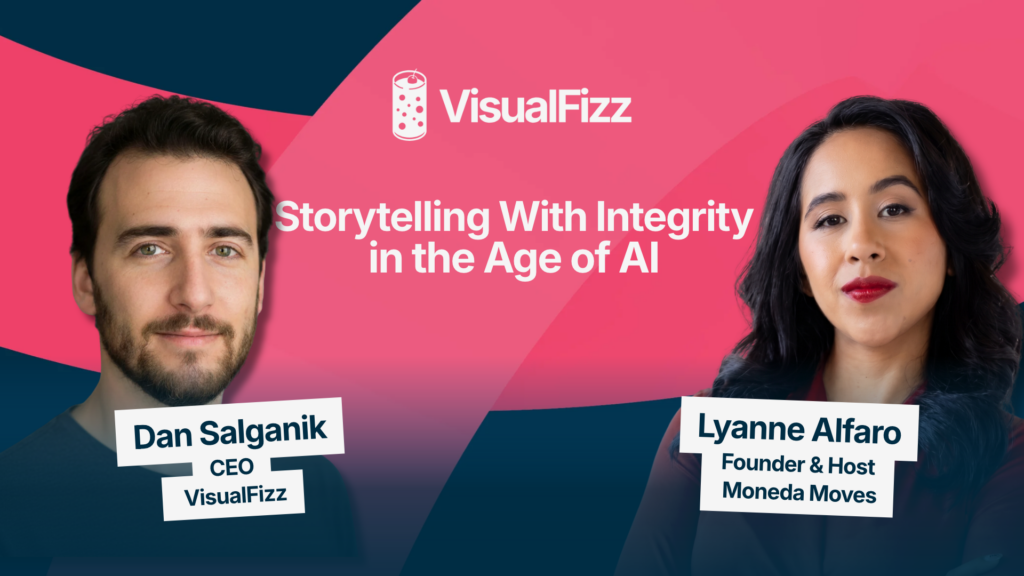
The VisualFizz Growth Series continues. In this episode, CEO Dan Salganik sits down with award-winning journalist and narrative advisor Lyanne Alfaro for a conversation about what good storytelling really means, why integrity matters more than authenticity, and how founders can stand out in a chaotic, AI-saturated media era.
“Good storytelling doesn’t only make you feel something. It tells you why you should feel something, and to what end.”
In this episode of the VisualFizz Growth Series, CEO Dan Salganik talks with Lyanne Alfaro, a journalist turned narrative advisor whose career has moved between national newsrooms and institutions like Nasdaq and Google. The conversation ranged across the chaos of the current media era, where the line between authentic and inauthentic really sits, and why she would rather talk about integrity than authenticity at all. Here is what they covered.
Meet the Guest: Lyanne Alfaro
Lyanne is an award-winning journalist and narrative advisor who counsels leaders and organizations on building credibility through journalism-informed marketing. Her career has moved between national newsrooms and influential institutions, a path that sharpened her understanding of how narratives are formed and legitimized. She began in business journalism, reporting on companies and the forces behind them, before working inside the organizations where narrative is built.
At Google, Lyanne led marketing across global developer channels, shaping how emerging technologies were understood by technical and non-technical audiences worldwide. Previously, at Nasdaq, she worked closely with IPO-stage companies, advising on communications strategy, hosting on-air conversations with founders and executives, and launching the company’s first podcast, Tomorrow’s Capital, with CEO Adena Friedman. Alongside her institutional work, she founded Moneda Moves, a media platform and storytelling practice examining how Latinos are shaping the U.S. economy and the future of capital. Through her consulting company, Project Reliable, she now helps founders and organizations position themselves credibly in the market and is building media literacy education for the everyday person. Her work has been recognized by TIME, the New York Emmys, the Webbys, Digiday, and PRNews, with bylines in Forbes, CNBC, and other national outlets.
The Chaotic, Messy Middle of the AI Era
Dan opened with a contrarian take: has storytelling gone to the wayside, now that brands can be built and pushed out so fast that founders no longer get the time to fail, fix, and find the real story? Lyanne’s answer placed the moment on a longer arc.
She described the online world as being in a chaotic, messy middle, driven by the race toward AGI, mass tech layoffs from an over-indexing on what AI can do, and a flood of people pushed into entrepreneurship, often involuntarily. Her striking data point: nearly a million women in the United States had left the workforce as of this year.
“AI is just a hockey stick, but less linear. Straight up.”
Her key reframe was to put industrialization, social media, and AI all on the same technology timeline. Every new technology disrupts the workforce, and we are simply in the disruptive middle of this one. That means corrections are coming, and with them a renewed hunger for depth of expertise and discernment.
Differentiation Is Everything
If there was one piece of practical advice Lyanne returned to, it was differentiation. In a world where anyone can pose as an expert and AI can generate endless content, standing out is the whole game.
- Don’t spray and pray. It is easy to create a mill of AI content that never moves the bottom line.
- Know your audience and your bottom line. Find where your audience actually is, then double down there.
- Respect timing. Press for press’s sake is not a win. Map your milestones, then build relationships early so you can tell the story in the right place at the right time.
She also framed expertise in journalistic terms: figure out your beat, the narrow area where you have real depth, and keep showing your work when it comes to discernment. Dan agreed, noting that AI is simply the next notch on the tech timeline, much like social media, an industry barely 20 years old that created entire job categories, and one we cover from a brand perspective in the changing role of social media in B2B marketing.
Companies Should Set Their Own AI Guidelines
One of Lyanne’s sharpest points was that, absent federal regulation, companies should take agency and define their own standards for AI use, then be transparent with their audiences about it.
“People feel unsettled by AI at every level. It’s up to companies to provide some of that clarity.”
Dan connected it to the AI governance conversations he has had at conferences with mid-market B2B companies doing half a billion to a few billion in revenue, where the approach varies heavily from one organization to the next. Transparency around AI, they agreed, is becoming part of building credibility itself.
What Good Storytelling Actually Is
Asked the deceptively simple question of what makes good storytelling, Lyanne gave the line that anchors the episode: it makes you feel something, tells you why you should care, and gives you a call to action.
Outside the business context, she has spent the past year doing personal storytelling, standing in rooms of strangers and simply sharing her life, and was reminded how powerful it is when someone says “I saw myself in your story.”
“Storytelling has the power to move a society.”
Dan built on his own view of storytelling through brands, pointing to companies like Whole Foods and Zappos whose stories were built over years by passionate founders solving a real problem. The worry both share is that today’s pace can rob founders of the time those stories need to develop.
How Much of Your Personal Life Belongs in Business?
A rich stretch of the conversation tackled a question that had come up inside Dan’s own team: how much personal storytelling is appropriate in a professional setting? Lyanne’s honest answer was that it depends on the business you are building and the kind of leader you are.
She contrasted two models:
- The old-school approach. Keep the mess behind the scenes, work through conflict privately, and share the story only once it is resolved and you feel regulated as a leader.
- The build-in-public approach. Common among younger founders and especially content creators, who built audiences first by sharing hardships and getting real about difficulties, then turned that trust into business.
Neither is wrong. The guiding questions she offered are always who is your audience, and what kind of leader are you, because each approach demands a different capacity to sit with discomfort while still leading the company.
Dan agreed and offered his own B2B take: he becomes inauthentic when he forces himself into blandness. He molds to the room, buttoned-up for a conservative old-school business, lighthearted where it fits, but he leans toward personality and storytelling in pitches. He shared a candid real-world lesson: once, being overly transparent about a project that dragged from eight months to sixteen actually cost him a pitch, while the same honesty has won him other relationships. The takeaway both landed on is that the right amount of openness tends to match you with the best-fit clients anyway, a theme that runs through our most common pain points in B2B marketing.
Finding the Right-Fit Clients
Lyanne was clear that not all business is good business. Entering an era of working with clients of her choosing, she prioritizes value alignment, guards hard against scope creep, and defines up front what success looks like so every party stays aligned.
“What good is it to have good outcomes and a terrible experience the eight or eighteen months that we work together?”
Dan echoed it from the agency side, noting that VisualFizz does not forge fake case studies. Some client relationships died with COVID or ended with a change in leadership, and the team still celebrates the work and the relationship that existed rather than pretending the outcome was different. This mirrors the ownership-first standard we lay out in our guide to choosing a B2B marketing agency.
Integrity Over Authenticity
Asked whether brands are more or less authentic than they used to be, Lyanne pushed back on the premise, and gave the episode its most quotable turn. What consumers perceive is different from what is, she argued, and what is has not really changed.
She reached for the Elizabeth Holmes saga as her example: a superstar company splashed on magazine covers that turned out to be a fraud, a story the media has now told through a whistleblower report, a book, an HBO series, and most recently a documentary. Her point was about where money and attention flow, and why sensationalism and shiny-object syndrome keep getting rewarded.
“I don’t know if I like the word authenticity anymore. Let’s talk about integrity. What do you owe the people you said you would serve?”
For Lyanne, integrity means doing what you said you would do, with no federal entity holding you accountable, only your customers, because it costs them. Those are the kinds of companies, and founders, she wants to build with.
Transparency Creates Authenticity
Dan offered a concrete counterpoint from his own work: an employee-owned industrial commodity client where he ran two video shoots interviewing everyone from the lowest person on the totem pole to the CEO. The people at the entry level spoke so highly of the company, how it would let them retire well and build a small fortune for their families, that the authenticity was undeniable.
“Most of their employees spend twenty years there and retire. Once they get that job, they never leave. To me, that is authenticity.”
Lyanne tied it back to trust. Citing the Edelman Trust Barometer, she noted that while trust in big institutions has fallen, people who stay at their companies tend to trust their CEOs more, which gives good employers a real opportunity to provide assurance and transparency to their teams. Together they landed on a clean formulation: transparency creates authenticity, because you are what you say you are. For many of the industrial and manufacturing brands VisualFizz serves, that story lives in the work itself, as our B2B marketing case studies show.
The One Piece of Advice: Diversify and Own Your Lane
As the two traded views on the job market, Dan was candid that the next few years will be hard for junior-level talent across almost any non-physical industry, even as the disruption opens the door for consultants and entrepreneurs. The best time to start a business, he noted, is often during a downturn.
His parting conviction doubled as the episode’s closing advice: the agency owners who stay quiet and just do the thing they are good at will have a tough time. VisualFizz has grown by diversifying its capability, moving away from being an agnostic agency, and focusing hard on what it does best, driven by senior talent.
“You have to find your place, own it, and be the lead at it.”
Lyanne agreed, adding her own caution against spraying content everywhere and her commitment to the same strategic discipline she advises for clients. Differentiation, both concluded, is crucial in this day and age.
Explore our Growth Series
Watch the full conversation with Lyanne Alfaro here, and explore the rest of the Growth Series for more conversations with the people building and scaling brands.
Learn more about Lyanne’s work at Moneda Moves and connect with her on LinkedIn.
Follow VisualFizz on LinkedIn, Instagram, Facebook, Twitter/X, and YouTube.
Upgrade Your Marketing
Chat with a team that understands well-developed, full-service marketing.
Publishing Date: