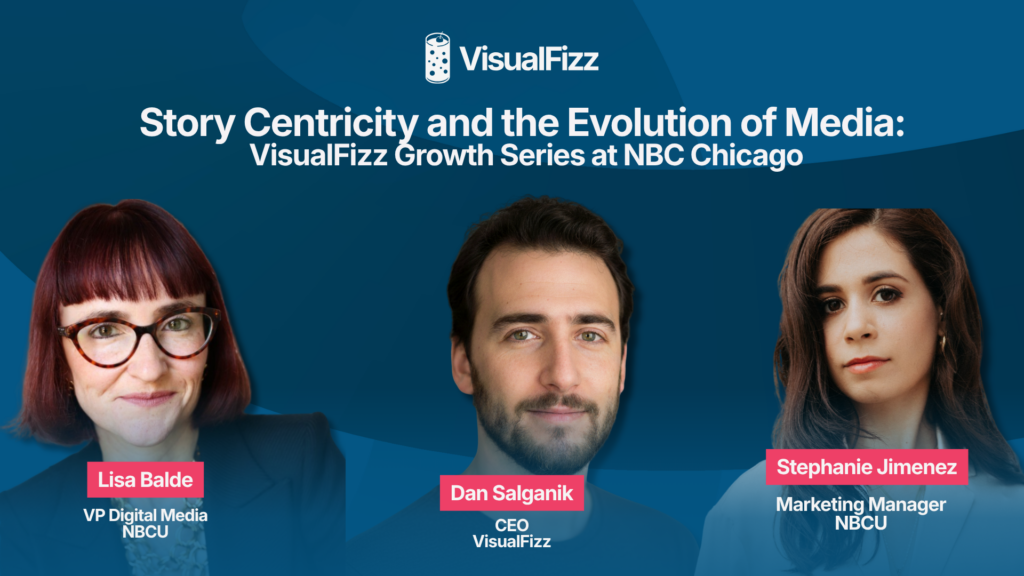
The VisualFizz Growth Series continues, this time on location. CEO Dan Salganik heads to the NBCU Local Chicago media center to sit down with Lisa Balde and Stephanie Jimenez of NBC Chicago and Telemundo Chicago for a conversation about how media has transformed, why authenticity and trust win, and what marketers everywhere can learn from a newsroom built for the way people actually consume content today.
“In the past, the audience came to us. Now they expect us to come to them. If they happen upon us, they’ll choose to consume, but if not, you’re irrelevant.”
For this episode of the VisualFizz Growth Series, CEO Dan Salganik recorded on location at the NBCU Local Chicago media center with two leaders shaping how a major market tells its stories. The conversation ranged across platform fragmentation, brand preference, the weather app that started a social campaign, AI, and the enduring power of human connection. Here is what they covered.
Meet the Guests: Lisa Balde and Stephanie Jimenez
Lisa Balde is Vice President of Digital Media at NBC Chicago and Telemundo Chicago, where she recently celebrated her 15th year. Lisa leads digital strategy and multiplatform content operations for both brands, overseeing audience growth, workflow transformation, and execution across web, app, social, YouTube, streaming, and emerging platforms. She played an integral role in redesigning the newsroom into a 21st-century cross-platform media center, and she leads the newsroom’s story-centric committee, guiding editorial leaders through a major transformation in how stories are produced and distributed.
Stephanie Jimenez is a PromaxBDA and Emmy Award-winning leader who oversees brand and creative marketing for NBC Chicago. As Marketing and Creative Services Manager, she translates audience research and emerging media trends into strategies that strengthen brand identity and reach new audiences. She leads a team of producers creating campaigns across broadcast, streaming, digital, social, and paid media, spanning local news, original programming, and major events including the Super Bowl, Olympics, World Cup, Bank of America Chicago Marathon, and the NASCAR Chicago Street Race, whose inaugural broadcast ranked number one among the top 50-plus DMA markets. A valedictorian graduate of Columbia College Chicago, she is currently helping launch a new YouTube channel for Open House Chicago.
From One Website to 13 Platforms: The Evolution of Media
When Lisa started in 2011, the operation was a single NBC website plus Twitter and Facebook. Fifteen years later, it is a duopoly of NBC and Telemundo spanning roughly 13 platforms each: social, YouTube, audio, streaming, and FAST channels. That growth is not vanity, it directly represents how people now consume content.
The brand-new media center Dan was sitting in, with its downtown Chicago view and dedicated podcast studio, is the physical embodiment of that shift. A year earlier, the space did not exist. Now the newsroom is a shared, collaborative environment producing content in both English and Spanish, built around the audience rather than around any single broadcast.
Tune-In to Brand Preference: The Biggest Strategic Shift
Stephanie framed the central change in the business. Years ago, consumption was concentrated across a handful of products, and it was safe to assume you could drive appointment viewing: watch this big story tonight at 10. That is no longer how people behave.
Consumption is now fragmented, and the competition is not just other TV stations but influencers, creators, and streamers all fighting for attention. So the priority shifted:
- From tune-in to brand preference. The goal is to be the brand people choose whenever and wherever they want local news, whether that is the 10 o’clock broadcast, a core digital product, or streaming.
- Live events remain tune-in gold. Sports like the World Cup, the Super Bowl, and the Olympics still command appointment viewing.
- Daily news needs a unique angle. Because push alerts and social deliver breaking news instantly, simply promoting the story of the day feels like old news. The answer is beat reporters and subject-matter experts whose insight you cannot get from a simple Google search.
As Lisa put it, the two pillars are relevance and a clear value proposition: what is in it for the audience, and why should they trust you, in an era when trust is hard to earn.
The Three-Second Window and the Fight for Relevance
Dan noted that a brand often gets only a few seconds to convey trust and relevance before a swipe. Lisa’s response: five seconds is far too generous, and even the near-ubiquitous three-second standard is becoming generous. At a moment when people need information more than ever, there is almost too much of it, and audiences struggle to find what they actually need.
Stephanie added that attention is only half the battle. The real challenge is moving people from awareness to familiarity to loyalty and trust. Her example was memorable: with phones constantly running low on storage, what makes your app worthy of the space?
The Weather App That Became a Social Campaign
The most entertaining segment was a perfect case study in turning a real observation into content. The team had noticed for years that the generic weather widget people rely on is often wrong, especially with precipitation, while the NBC Telemundo Chicago app’s weather is remarkably accurate.
So Stephanie captured it live. Waiting out the snow at a Sweetgreen, she screen-recorded the basic phone weather next to the NBC Chicago forecast, two completely different stories, then panned up to show it was already snowing.
“We’re like, let’s post it. We have to.”
Lisa drove the point home with a story of challenging her own husband’s 3 percent chance of rain (the app said 99 percent) right before a bad storm they had staffed around. The lesson for marketers is that authentic, real-world proof of why your product is better is some of the most powerful content you can make, and it feeds the word-of-mouth loop you can never directly track.
Dan connected it to a sobering stat for anyone building an app: the number of apps the average American downloads per month rounds to zero. Earning a permanent place on someone’s phone requires genuine engagement and loyalty, which is exactly what NBC Chicago found: their app audience is their most loyal audience across all digital products.
Story Centricity: The Story Comes Before the Platform
Lisa introduced the concept driving the newsroom’s transformation: story centricity. For years, the industry led with the platform. What leads the 10 o’clock? What does TikTok want? What goes on the homepage? Story centricity flips that.
“It’s about the story. What’s a story you tell so well that people are going to talk about it and tell their friends?”
The team thinks in funnel terms: top-of-funnel reach from social and Google Discover, then building the affinity and value that pulls people deeper. It all comes down to storytelling and the hook, the same principle behind the Sweetgreen weather moment. This mirrors how strong content marketing works in any industry: lead with the story, then adapt it to each channel.
Respect the Platform: One Story, Many Expressions
Stephanie was candid about a lesson learned the hard way. When she started, the team might drop a TV promo onto Instagram as-is. You simply cannot do that anymore. Each platform deserves respect for what it is and how its audience wants to receive content.
The Telemundo World Cup work is a great example of cultural relevance done right. Rather than assuming English speakers watch English coverage, the team leaned into the idea that soccer, and sports generally, transcend language. Inspired by a viewer who loved telenovelas despite not speaking Spanish, they built campaigns around the feeling that “soccer sounds better in Spanish.” You cannot fake that cultural relevance, which is why diverse teams with different backgrounds matter so much. Dan agreed, noting the World Cup on Telemundo felt more exciting even watching alone.
The takeaway for marketers: start with the campaign goal at the top, then express it differently on each platform. As Stephanie put it, content is marketing, which is precisely why Dan was interviewing both a content leader and a marketing leader together.
Listen to Your Audience, Especially the Silence
Lisa shared one of the sharpest ideas in the episode. Reaching the audience where they are means playing by each platform’s rules, and it also means truly listening, including when people do not respond.
Her Telemundo discoverability story illustrates it. Frustrated by a ceiling on how audiences found Spanish-language content, she asked a friend how they got their information. The answer: WhatsApp, of course, a platform Americans often overlook despite it being one of the largest in the world. So the team built a WhatsApp presence and opened a channel for a genuine audience feedback loop.
“How are you listening to your audience? They will reward you, but you also must listen when they don’t respond to something.”
The content that performs best is the content that impacts people directly: money, health, and yes, the memorable cyclosporiasis story that became one of the month’s biggest hits precisely because it affected everyone.
Authenticity, Talent, and the Human Element
Dan steered the conversation toward inauthenticity, the flood of AI-generated and artificially inflated content. Lisa’s answer was clear: audiences are getting smarter by the day, and you must respect that.
“If it looks like you’re trying to sell them on something, people don’t want it.”
Two responses stood out. First, NBC Chicago’s News Content Creator Program trains journalists, who are experts at telling news, to become storytellers on social platforms like TikTok, which is now a real destination for local news rather than just a dancing app. The follower growth has been exponential, but the team measures impact, not vanity metrics.
Second, on the marketing side, Stephanie described a post-COVID shift toward talent as the faces of the brand. People do not just love “channel five,” they love anchors like Allison Rosati, and for Rosati’s 35th anniversary the team filmed her at home, revealing the person behind the journalist. Pairing that personal vulnerability with decades of institutional credibility is how you build trust against a sea of influencers.
Dan tied it back to his own world:
“My world is predominantly B2B marketing, and I have to remind people that we are selling to people.”
Whether it is a news anchor or an industrial brand, the winning move is remembering that both sides of the equation are human.
The Biggest Challenges: Fragmentation, Change, and Risk
Asked about their biggest career challenges over the past decade-plus, each leader offered something different:
- Lisa: leading change from legacy to new media. Digital is no longer the future of news, it is the present. Her committee’s mantra: if you do it the way you have always done it, you will get what you have always gotten. When she caught herself opening social media for news before her own news app, the team front-loaded social into its strategy and built three-second-hook training for the morning show.
- Stephanie: managing fragmentation and risk. It is not just resizing one asset into many aspect ratios, it is different messaging per platform (brand awareness versus call to action) all under one campaign, for different audiences. And because marketing is part research and part art, taking creative risks means opening yourself to criticism, a constant balancing act.
- Dan: doing more with finite budgets in the age of AI. AI has opened the floodgates to competition and misinformation while also enabling real leaps forward. For the manufacturing, industrial, and construction brands VisualFizz serves, the challenge is convincing 30, 50, and 100-year-old companies that “this is how we’ve always done it” will not carry the next 50 years, especially as LinkedIn increasingly favors senior leaders as thought leaders over brand pages.
SEO Is Not Dead, It Evolved
Both sides agreed on a point close to Dan’s heart. Google’s AI overviews now answer questions directly, breaking the old bridge between content and audience. But Lisa noted a silver lining: with casual traffic scraped off the top, they can see their most loyal audience more clearly than ever.
“SEO is not dead. It’s an algorithmic change. It’s simply changed.”
Dan’s take is that SEO has grown more nuanced, not obsolete, and his team has expanded its SEO department accordingly. It is no longer 5,000-word articles, just as news is no longer a single 10 p.m. report, but pieces that guide people to the end result. Interestingly, both teams have found that audiences arriving via AI-driven research often convert at a higher rate, because they arrive with intent. It is a clip culture now, and the job is using content to pull people further down the funnel, the way NBC’s 7 a.m. streaming continuation of the morning show found its audience organically after viewers wanted local headlines past the network cut-in.
The One Thing They Want to Carry Forward
To close, each shared a goal for the years ahead:
- Lisa is passionate about story centricity spreading across the news industry, and about pulling best practices from platforms like YouTube into linear television, so the newscast itself feels different and fresh.
- Stephanie wants to leverage AI on the creative side, using the building’s Studio C to create virtual sets and use the space in new ways.
- Lisa added the one that matters most: empowering people to be future leaders. Invest in people, and the company grows along with them.
Dan agreed wholeheartedly, pushing back on the trend of AI-only agencies:
“This is why we do stuff. It’s to develop these little communities that we call brands or businesses.”
Explore the full Growth Series Here
This was a special on-location episode of the VisualFizz Growth Series, filmed at the NBCU Local Chicago media center. Watch the full conversation with Lisa Balde and Stephanie Jimenez here, and explore the rest of the Growth Series for more conversations with the people building and scaling brands.
Follow NBC Chicago at nbcchicago.com and Telemundo Chicago at telemundochicago.com. Connect with Lisa Balde on LinkedIn and Stephanie Jimenez on LinkedIn.
Follow VisualFizz on LinkedIn, Instagram, Facebook, Twitter/X, and YouTube.
Upgrade Your Marketing
Chat with a team that understands well-developed, full-service marketing.
Publishing Date: