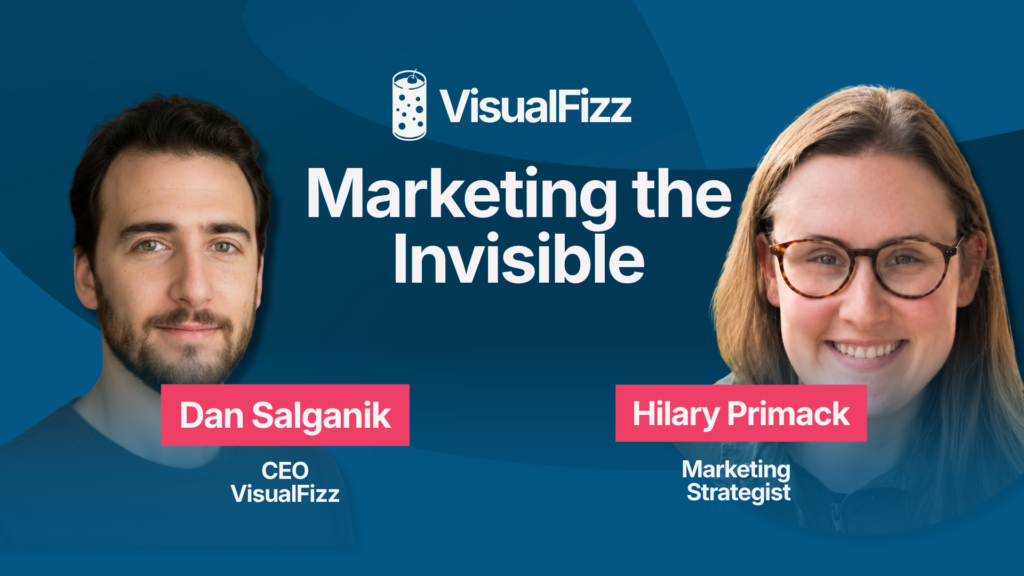
The VisualFizz Growth Series continues. In this episode, CEO Dan Salganik sits down with Hilary Primack, a human-centric marketer working at the intersection of the restaurant industry, recycling, and energy, for a conversation about building brand awareness for the businesses most people never think about until they need them.
“We are an industry where people only think about us when there’s a problem, a need, or they’re not in compliance. For the most part, we’re behind the scenes.”
Some of the most essential companies in the world are the ones no one notices. In this episode of the VisualFizz Growth Series, CEO Dan Salganik talks with Hilary Primack about marketing behind-the-scenes B2B organizations, defining an ideal customer in a niche industry, working hand-in-hand with sales, and keeping humans at the center of everything, even in the age of AI. Here is what they covered.
Meet the Guest: Hilary Primack
Hilary is a human-centric marketing professional who brings a people-first lens to every campaign. With more than a decade in marketing, she has turned empathy into results, leading teams, securing media placements in major national outlets, and driving growth across SEO and social media. She holds a Master of Social Work from the University of Southern California and a BS in Human Services from the University of Delaware, experiences that shape her view of marketing as connection, not just conversion.
Her career has spanned higher education, membership organizations, and now the intersection of the restaurant industry, recycling, energy, and oil and gas. Through every pivot she has stayed focused on the customer and what customers actually need. Outside of work, Hilary serves on the Auxiliary Board of the Auditorium Theater and volunteers with CASA, channeling the same commitment to advocacy and empowering others.
The Challenge of Marketing a Behind-the-Scenes Brand
Hilary works in a space that most people, even those inside B2B, never think about, yet it is essential to daily life. As she put it, if the operations team is doing its job, customers never need to know the company exists. That is an unusual position for a brand to be in.
It also creates an opportunity. Rather than resign itself to invisibility, a behind-the-scenes company can choose to put itself in the spotlight and do something groundbreaking. Hilary manages brand awareness across many levels at once, from restaurant owners who are not always on site, to employees who may not know the company by name, to consumers who want to support sustainable organizations.
Dan connected it to his own experience with clients in spaces like concrete and construction, noting how few people realize that the vast majority of concrete and cement gets recycled. The lesson is that these companies are not just revenue generators and job creators, they are quietly building a cleaner, more sustainable world for the rest of us.
Interestingly, Hilary landed here somewhat by chance, through a recruiter in 2021, only to realize it was the culmination of an early passion for environmental studies and a favorite college course in agricultural economics. Sometimes the unintentional path is the right one.
Defining an ICP When Your Customer Is an Industry
In a highly specialized industry, the ideal customer profile looks different. Rather than starting with a specific type of person, Hilary starts with the industry itself as the ICP, then drills down.
- Start at the industry level. Target a category first, for example, hotels.
- Then find the personas within it. Inside a single hotel, you might be speaking to operations, facilities, or procurement.
- Adapt over time. The right target shifts depending on the organization, the brand, and what each persona needs to hear.
Because her services are need-based, the qualifying question is refreshingly black and white: does this customer need the service now or in the future, and are they already under contract with someone else? That clarity means leads often move to sales quickly. To keep a personal touch, the team does manual, one-to-one outreach, including finding new customers on Instagram and sending a direct message to introduce themselves, which feels far more human than a large corporate blast.
Marketing and Sales Cannot Be Separated
This is a theme close to home for VisualFizz, and central to VF3, our VisualFizz 3.0 relaunch. Too many agencies and marketing teams stop at the conversion and never learn what happens after.
Dan described the mountain: you climb all the way up to the conversion at the peak, only to realize you still have to climb down the other side. Marketing-qualified leads, proposals sent, proposals closed, and then the part he has been honing in on most: what happens after the sale.
“The toughest and most expensive thing is getting the conversion. The cheapest thing is maintaining the new customer and scaling them up. You can 5 or 10x a customer with 10% of the work.”
Hilary is very hands-on with her sales team. A few practices stood out:
- Weekly Monday lead reports. She sends sales leadership a report on website and advertising leads, the ones that cost the most to generate, broken down by market.
- Accountability by the numbers. Inbound website leads should close quickly, so the report keeps everyone aware of what is still open and protects ROI.
- Involvement in proposals and RFPs. For larger opportunities, she helps assemble the proposal and make sure it has everything it needs.
- Lifecycle and retention planning. As the tech stack grows, she is focused on how and when to communicate with customers so they stay and eventually sign up for more services.
Dan reinforced the point that the old “seven touch points” idea no longer holds. For complex B2B organizations dealing with hotels, parent companies, and procurement teams, he puts it closer to 20 touch points, each one building trust.
AI and AEO: Optimize Everything, Drop Nothing
When the conversation turned to AI, Hilary’s focus was practical: optimizing existing content so it surfaces when people search in large language models, because falling behind the newest way of searching is not an option.
She also stressed how integrated content has become. A single piece now has to be optimized for SEO and AEO, carry the right keywords, work as an ad, and live on the website all at once.
“Everything has become so integrated because of AEO that you can’t drop the ball on any part of your content machine. It’s going to impact some form of search now.”
On the spicier question of whether writing for the algorithms has overtaken the human element, Hilary was clear about where she stands.
“I always focus on humans, because humans are the ones teaching the robots. The robots have to pick up on the nuances of the humans.”
Her human-centric approach means creating for people first and trusting that the platforms will follow.
The Channels That Actually Work in Complex B2B
Asked to name the top one or two channels for winning new B2B customers, Hilary went twofold: your website and your Google Business Profile.
The website is foundational because it is what SEO and AEO promote. Google Business pages matter because reviews and word of mouth carry enormous weight, and because they feed directly back into SEO and AEO whether we like it or not.
Dan built on this with a metaphor he keeps coming back to: your website is your top salesperson. When people ask him for a pitch deck or a capabilities deck, he points them to the website.
“It’s your house. You invite people in to do their due diligence, to look around.”
He also made a strong case for case studies, which Hilary confirmed her company features prominently. Case studies have become even more important because people want to hear from real customers, and because search engines and tools like ChatGPT treat them as proof points when deciding whether to reference your site. Dan’s rule of thumb is that every B2B company should have at least ten, and often many more.
Word of Mouth and the Rise of Smarter Searchers
The most powerful marketing channel is also the one you can never track: genuine word of mouth. As Dan noted, a recommendation could happen in the back of an Uber, over dinner, or in a text message, and you would never know it happened, yet it is priceless.
There is also a shift in how people search. Queries have moved from robotic short phrases like “best agency Chicago” to hyper-specific, long-tail, often voice-driven questions like “the top marketing agency in Chicago that focuses on B2B for mid-sized companies doing a hundred million or more.”
Hilary offered the encouraging flip side:
“The consumer is getting smarter at figuring out how to make sure the companies they work with really align with their business needs.”
Searches are getting more specific because buyers now know the right-fit companies are out there, and they expect answers that are genuinely useful rather than generic.
The One Piece of Advice: Where a Small Team Should Start
Hilary turned the tables and asked Dan a great question: if you were on a smaller team with limited resources, what would you prioritize? His answer, in order:
- A solid digital foundation, starting with the website. Get the basics of SEO in place, either by hiring out, learning it, or having a professional set the foundation so you can own it afterward. Building a website and expecting people to show up does not work.
- One social channel you truly own. Rather than spreading thin, dominate one channel (LinkedIn works well for VisualFizz) and simply maintain a presence on the others, at something like a four-to-one ratio.
- Brand and visual consistency. For a team with one marketer and ten salespeople, make sure the website, emails, one-sheeters, spec sheets, and proposals all look consistent. It is largely a one-time build that pays off for years.
The throughline: a clean website, some proof of concept, and an active presence on one channel will take a small team a long way.
Explore the full Growth Series Here
This was another episode in the relaunched VisualFizz Growth Series, with VF3 rolling out in the coming months and more conversations on the way. Watch the full conversation with Hilary Primack here, and explore the rest of the Growth Series for more discussions with the people building and scaling brands.
Hilary is also a member of Marketing Women, a global group of women and non-binary marketers who help each other level up, problem-solve, and support one another through career challenges. A great reminder from both hosts: join a group where you can trade ideas without judgment.
Connect with Hilary Primack on LinkedIn.
Follow VisualFizz on LinkedIn, Instagram, Facebook, Twitter/X, and YouTube.
Upgrade Your Marketing
Chat with a team that understands well-developed, full-service marketing.
Publishing Date: