At some point, every growing B2B company faces the same question: should we build an internal marketing team or hire an agency?
The answer isn’t as simple as comparing a salary to a retainer. The real calculation involves total cost of employment, capability gaps, ramp-up time, management overhead, and the opportunity cost of getting it wrong. A bad in-house hire can set your marketing back 12 to 18 months. A bad agency choice can burn through six figures with nothing to show for it.
This guide breaks down the real costs on both sides, the situations where each model works best, and the hybrid approach that many B2B companies find is the most practical path forward.

The Real Cost of an In-House B2B Marketing Team
The sticker price of an in-house marketing hire is the salary. The actual cost is significantly higher.
Salary alone doesn’t capture the full picture. A mid-level marketing manager in the U.S. earns between $75,000 and $110,000 annually, according to Bureau of Labor Statistics data and Glassdoor salary benchmarks. A senior marketing director or VP can run $130,000 to $200,000+. But salary is only part of the equation.
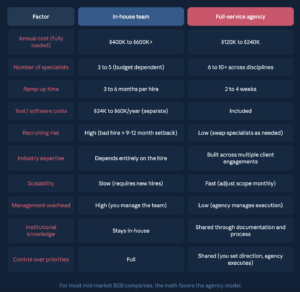
Total cost of employment adds 25% to 40%. Benefits (health insurance, 401k match, PTO), payroll taxes (FICA, unemployment insurance), equipment (laptop, software licenses), and office or remote workspace costs push the true annual cost of a $100,000 employee to $125,000 to $140,000.
You need more than one person. A single marketing hire, no matter how talented, cannot cover SEO, PPC, content creation, web development, analytics, design, and strategy. A functional in-house B2B marketing team typically requires at minimum a marketing director ($120K to $180K), a content writer or content marketer ($60K to $85K), a digital marketing specialist handling SEO and paid media ($65K to $95K), and a designer ($60K to $85K). Fully loaded, that’s $380,000 to $550,000 annually before tools, media spend, or training.
Software and tools add up. A standard B2B marketing tech stack (CRM, marketing automation, SEO tools, analytics, design software, project management) runs $2,000 to $5,000 per month. That’s $24,000 to $60,000 per year on top of team costs.
Recruiting and ramp-up time are hidden costs. The Society for Human Resource Management (SHRM) estimates that the average cost to hire a new employee is roughly $4,700, and the average time to fill a marketing role is 36 to 49 days. Then add 3 to 6 months for the new hire to fully ramp up, learn your industry, understand your buyers, and start producing meaningful work. If that hire doesn’t work out, the cycle restarts, and you’ve lost 9 to 12 months.
The bottom line: a functional in-house B2B marketing team costs $400,000 to $600,000+ per year when you account for salaries, benefits, tools, recruiting, and overhead. And that team still may not have deep expertise in every discipline your marketing strategy requires.
What You Actually Get From a Full-Service B2B Agency
An agency engagement consolidates multiple specialists, tools, and capabilities into a single monthly investment. Here’s what that typically includes for B2B companies.
A team of specialists, not one generalist. A full-service agency provides access to SEO analysts, PPC managers, content strategists, designers, web developers, and a senior strategist or account director, all working on your account. You’re not paying for one person trying to do everything. You’re paying for the right person doing each thing.
Tools and technology are included. The agency’s SEO tools, analytics platforms, design software, project management systems, and reporting dashboards are part of the engagement. You don’t pay separately for Semrush, Ahrefs, Adobe Creative Suite, or whatever else the team uses.
No recruiting, no ramp-up, no management overhead. An agency starts executing within weeks, not months. There’s no job posting, no interview process, no onboarding period. And you don’t manage the team’s day-to-day work, their PTO, their career development, or their performance reviews. Your time stays focused on running the business.
Scalable scope. Need to add PPC to your SEO program? An agency adds a specialist to the team. Need to pause a channel during a slow quarter? The scope adjusts. In-house teams don’t scale this way. Hiring someone for a 6-month need doesn’t make financial sense, but an agency can add and remove capabilities as your priorities shift.
Typical B2B agency investment. Full-service B2B agency retainers range from $8,000 to $20,000+ per month depending on scope, complexity, and the number of channels. At $15,000 per month, that’s $180,000 annually, roughly one-third to one-half the cost of a functional in-house team, with broader capability coverage.
Side-by-Side Comparison
When In-House Makes Sense
There are legitimate scenarios where building an internal team is the right call.
You have the budget and the volume. If your marketing needs are large enough to justify $500K+ in annual team costs, and you have enough ongoing work to keep 4 to 5 specialists fully utilized year-round, in-house can be cost-effective at scale. This typically applies to companies doing $50M+ in revenue with sustained marketing investment.
Your product or market requires deep, proprietary knowledge. Some B2B companies operate in markets so technical or regulated that an external team can’t realistically develop the expertise fast enough. If your marketing requires deep product knowledge that takes years to build (think medical devices, defense contracting, or highly specialized industrial equipment), in-house specialists who live and breathe the product have an advantage.
You need real-time agility. In-house teams can pivot instantly. If your market shifts, a product launch moves up, or a competitor makes a move, an internal team can respond the same day. Agency teams are responsive but operate on communication cycles that add natural latency.
You’re building a long-term marketing function. If marketing is a core strategic function (not just lead generation), building internal capability creates institutional knowledge and competitive advantage that compounds over time. The team understands the business at a depth that an external partner, no matter how good, can only approximate.
When an Agency Makes More Sense
For most mid-market B2B companies, an agency is the more practical choice. Here’s when it’s clearly the right move.
You need results now, not in six months. An agency brings a trained team that can start producing work in weeks. If you’re launching a new product, entering a new market, or need to fill pipeline quickly, waiting 6 months to hire and ramp an internal team isn’t an option.
You can’t afford a full team. If your budget is $10,000 to $20,000 per month for marketing, you can either hire one person (who can’t cover every channel) or engage an agency (that covers all of them). The math favors the agency until your marketing budget supports 4+ full-time hires.
You need specialized skills you don’t have internally. SEO, PPC, web development, brand strategy, and marketing analytics are distinct specializations. A single marketing hire rarely excels at all of them. An agency brings each specialist to the table without the overhead of individual hires.
Your current team is stretched thin. Many B2B companies have a marketing director or small team handling too many responsibilities. An agency doesn’t replace that team. It extends it by taking execution off their plate so they can focus on strategy, stakeholder management, and cross-functional alignment.
You’re in a niche B2B industry. Agencies that specialize in B2B industrial, construction, SaaS, or logistics marketing bring cross-client learning that an in-house generalist won’t have. They’ve seen what works (and what doesn’t) across dozens of companies in your space. That pattern recognition accelerates results.
The Hybrid Model: When You Need Both
For many B2B companies, the answer isn’t either/or. It’s both.
The hybrid model typically looks like this: an internal marketing director or small team owns the strategy, manages the brand, handles internal communications, and serves as the liaison between the agency and the rest of the business. The agency handles execution across specialized channels: SEO, PPC, content production, web development, and analytics.
This model works because it combines the depth of institutional knowledge (the internal team knows the product and the market) with the breadth of specialized execution (the agency brings skills the internal team doesn’t have). Neither side is trying to do the other’s job.
The hybrid model also provides a natural transition path. As the business grows and marketing matures, you can gradually bring capabilities in-house while reducing the agency’s scope. Or you can increase the agency’s scope as you enter new markets or launch new products. The flexibility is the point.
At VisualFizz, most of our B2B client relationships operate on a hybrid model. The client has internal marketing leadership. We provide the specialized execution team. The combination produces better outcomes than either model alone because strategy and execution stay connected.
Questions to Ask Before You Decide
Before committing to either path, answer these honestly.
What does your marketing actually need right now? If you need strategic direction and someone to own marketing at the leadership level, hire internally. If you need execution across multiple channels, engage an agency. If you need both, build the hybrid.
What is your realistic budget? Can you afford a full team ($400K to $600K+), or is your marketing budget in the $10K to $20K per month range? The budget determines which model is financially viable, not which one is theoretically ideal.
How quickly do you need results? If pipeline generation is urgent, the 6-month hiring and ramp-up cycle of an in-house team is a luxury you may not have.
Do you have the management capacity? An in-house team requires management: performance reviews, career development, conflict resolution, day-to-day oversight. If your leadership team is already stretched, adding 3 to 5 direct reports creates a management burden that affects everything else.
What happens if it doesn’t work? A failed in-house hire costs 9 to 12 months of lost time plus recruiting costs. A failed agency engagement costs the retainer for the contract term. Understand the downside risk of each option before you commit.

How VisualFizz Works as an Extension of Your Team
VisualFizz was built for the hybrid model. We work with B2B companies in industrial, construction, SaaS, and logistics industries where the sales cycles are long, the buyers are technical, and the marketing has to connect to the pipeline, not just traffic.
Our team functions as an extension of your internal marketing leadership. You set the business direction. We handle the specialized execution: SEO strategy and implementation, paid search campaign management, content creation and optimization, web development, and performance reporting tied to your commercial outcomes.
We don’t require long-term contracts to retain clients. We earn retention by producing measurable results and communicating them transparently. Every engagement includes full access to your accounts, regular strategy reviews, and reporting that connects marketing activity to leads, pipeline, and revenue.
The question isn’t really “agency or in-house.” The question is: what combination gives you the best marketing outcome for your budget, your timeline, and your growth goals?
Publishing Date: